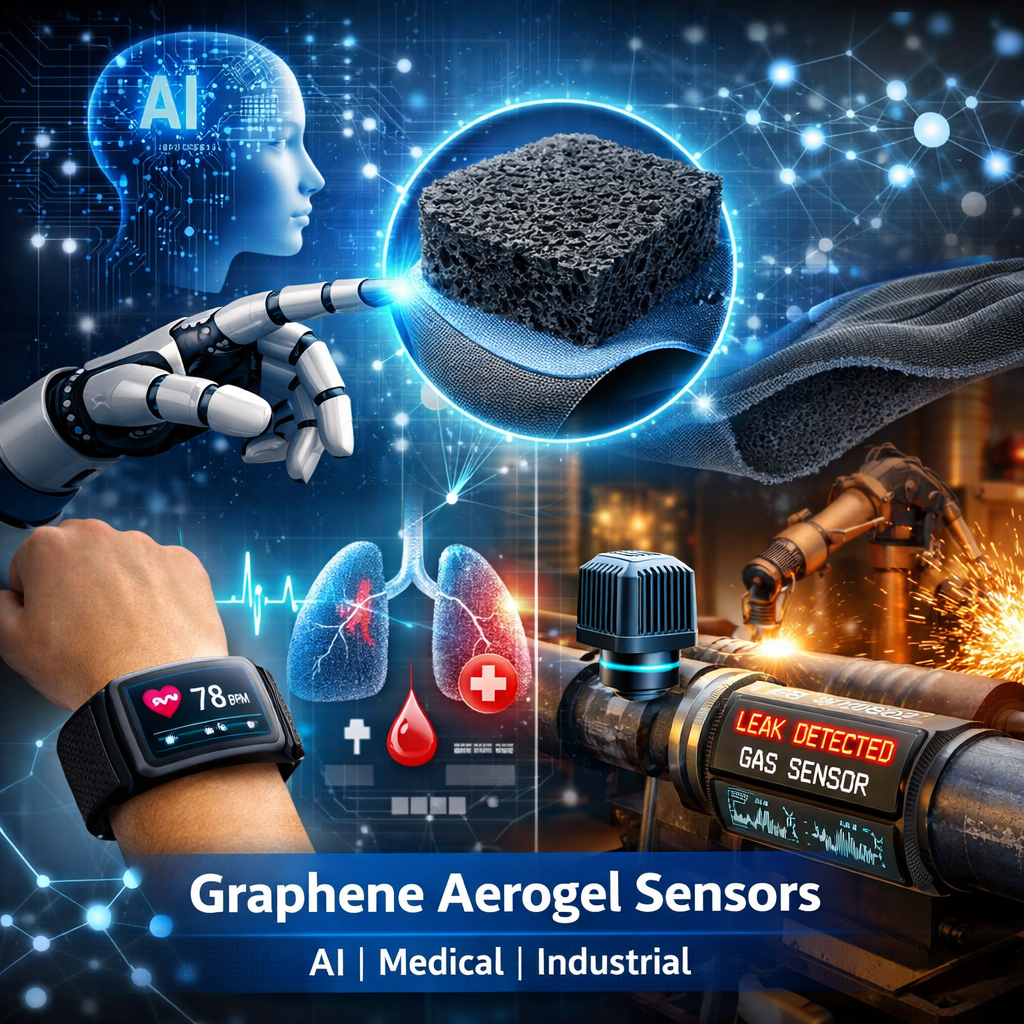
What Makes Graphene Aerogel Ideal for Sensors?
Graphene aerogel is a three-dimensional, ultra-light, highly porous nanomaterial composed of interconnected graphene sheets. Its unique structure provides several critical advantages for sensing applications:
Extremely high surface area Graphene aerogel offers a massive active surface area, allowing it to detect even the smallest physical, chemical, or environmental changes with high accuracy.
Excellent electrical conductivity Its conductive network enables rapid signal transmission, resulting in faster response times and improved sensor performance.
High sensitivity to external stimuli Graphene aerogel can detect changes in pressure, strain, temperature, and gas concentration with exceptional precision.
Mechanical flexibility and durability Its lightweight and elastic structure allows it to function effectively in flexible and wearable devices without performance degradation.
Applications in AI and Smart Systems
Graphene aerogel plays a key role in enabling intelligent systems by providing accurate and real-time data. In AI-driven environments, sensors made with graphene aerogel can be used for:
Smart robotics and tactile sensing
Human motion detection
Intelligent automation systems
Environmental monitoring
Its fast response and stability make it ideal for integration into advanced AI systems.
Applications in Medical and Wearable Sensors
Healthcare is one of the most promising fields for graphene aerogel sensor technology. Its lightweight and flexible nature allows it to be integrated into wearable and biomedical devices.
Key applications include:
Heart rate and respiration monitoring
Pressure and motion detection
Smart wearable health devices
Early disease detection systems
Graphene aerogel sensors can detect subtle physiological signals that conventional materials may miss, improving diagnostic accuracy.
Industrial Sensor Applications
In industrial environments, reliability and durability are essential. Graphene aerogel provides strong performance even under harsh conditions.
Applications include:
Gas detection sensors
Pressure sensors for industrial systems
Structural health monitoring
Safety and leak detection systems
Its chemical stability and conductivity ensure long-term performance and reliability.
The Future of Sensor Technology
Graphene aerogel is not just an improvement—it represents a major advancement in sensor materials. Its combination of ultra-high sensitivity, conductivity, flexibility, and stability makes it one of the most promising materials for future AI, medical, and industrial sensor technologies.
As industries move toward smarter, safer, and more connected systems, graphene aerogel will play a critical role in enabling highly accurate and efficient sensing solutions.
At Graphene Nano, we are actively developing high-quality graphene aerogel materials designed for advanced sensor applications, supporting the future of intelligent technologies.